
Finding Williamson County Resident Records
Williamson County has no single list of everyone at every address. The useful trail changes with the starting point. Use a present-day address to reach the Assessor and parcel map. Use a name to test a voter match, a deed-party index, or the Archives. For a family question, combine the library's city directories, yearbooks, newspapers, cemetery material, and probate references. Each result needs a second source before it becomes a reliable identification.
Ownership, registration, a court appearance, and a historical mention are different facts. A parcel owner may not occupy the site. A voter search does not include every person at an address. An archival index usually points to a book, reel, or file instead of supplying the record itself. Keeping those distinctions clear makes the Williamson County residents directory useful without overstating a match.
- Search the Williamson County Property Assessor by owner or address, then save the parcel and street details returned.
- Use GoVoteTN with the exact registered name or address when voter information is the right question.
- Follow a property owner through the Register of Deeds index and preserve the deed book, date, legal description, and party spelling.
- For an earlier household, ask Williamson County Public Library Special Collections for the pertinent directory, newspaper, or yearbook source.
- Send a specific request to the custodian when the online route ends, rather than asking an office to create a new list.
Note: Record the source date and exact spelling at each step, because a same-name result alone does not establish identity.
Williamson County Residents Office Routes
Franklin is the county seat, but the evidence behind a Williamson County residents directory is distributed among separate custodians. The Assessor maintains ownership and tax-roll work. The Register records instruments and provides the title-index route. The Election Commission supplies county election information and links to the state voter lookup. Historical names often move to the Archives or the library. For a full address-by-address sequence, use the Williamson County Streets page after identifying the parcel.
Register of Deeds
1320 West Main Street, Suite 201
Franklin, TN 37065
615-790-5706
Election Commission
405 Downs Boulevard
Franklin, TN 37064
615-790-5711
The Archives, at 611 W. Main Street in Franklin, is the historical fallback. Its public index points to microfilm, bound books, and loose files, while current deeds, marriages, and similar records remain with their modern custodians.
Williamson County Parcel Search Fields
The Assessor portal is the best first stop for a present parcel. Its exposed form accepts Owner Name, Property Address, Subdivision, City, Lot Number, Map, Parcel, and sale-date limits. The result list displays Owner(s), Property Address, City, Parcel Description, Lot Number, Sale Date, and Price. All displayed query fields were optional when inspected. The portal labels its output informational and prohibits bulk collection or redistribution.
| Portal field | Use in a Williamson County search | Result clue |
|---|---|---|
| Owner Name | Try the recorded name, initials, or last-first form | Owner(s) |
| Property Address | Find the situs, not a presumed mailing location | Address and city |
| Subdivision and lot | Bridge a street address to a plat or deed | Parcel description and lot |
| Map and parcel | Preserve the land identifier across systems | Selected parcel detail |
| Sale dates | Narrow a transaction period | Sale date and price |
The county's Internet Mapping viewer adds parcel geometry and context layers. Its REST parcel metadata separates situs fields from owner mailing fields, an important distinction when following a name.
Current Williamson County Residents Sources
Current directory-like sources are partial by design. They identify an owner, registered voter, deed party, public official, or designated neighborhood contact in a particular system. They should be read as separate record types, not merged into a claim that every person at an address is known. A name that appears in more than one independent record deserves closer review.
| Williamson County source | Person connection | Custodian | Access path |
|---|---|---|---|
| Property search | Current owner and parcel details | Property Assessor | Free informational portal |
| GoVoteTN | Registered-voter and election-information match | State and Election Commission | Name or address lookup |
| TitleSearcher | Grantors and grantees on recorded instruments | Register of Deeds | Index and paid image route |
| Franklin staff directory | Public-facing city staff contacts | City of Franklin | Searchable city directory |
| Neighborhood registration | Designated organization contact and boundaries | Franklin Planning | Public registration channel |
When the task is to verify one person rather than inspect an address, use a resident-lookup sequence that keeps the person, property, and historical records separate.
Williamson County Voter Lookup Limits
GoVoteTN offers two modes: search by voter and search by address. The voter mode uses required first and last name fields and accepts an optional ZIP. Address mode accepts a street address, ZIP, city, and state. A successful public match can provide registration and election information such as polling place, districts, officials, or a sample ballot. It is not a countywide resident roll and does not show ballot choices.
Tennessee protects Social Security numbers, driver-license and Department of Safety identifiers, and certain voter documentation. Protected participants in the Safe at Home program must not be exposed through a resident search. The Election Commission can explain current registration questions, while the state tool remains the public lookup route.
Williamson County Deed Trail Cutoff
The Register's TitleSearcher coverage creates a practical break in the modern property trail. Its county page identifies online deed index and image coverage from January 1, 1981 to the present. It also identifies old index books for 1951 through 1980 and non-indexed images in Books A1 through 379. An older address has not necessarily disappeared when an online name search ends. It may require the old books, an office visit, or the Archives Reading Room.
Start with the parcel's legal description and current owner, find the purchase deed, then use the seller as the next earlier grantee. Record book and page references, subdivision or lot, date, and spelling each time. A postal address is not always in a deed, so a legal description is the continuity key. TitleSearcher describes cross-references and refer-backs as chain tools, and a “Not Indexed” label means the instrument has not been verified or certified.
See the Williamson County TitleSearcher coverage page before opening the image route.
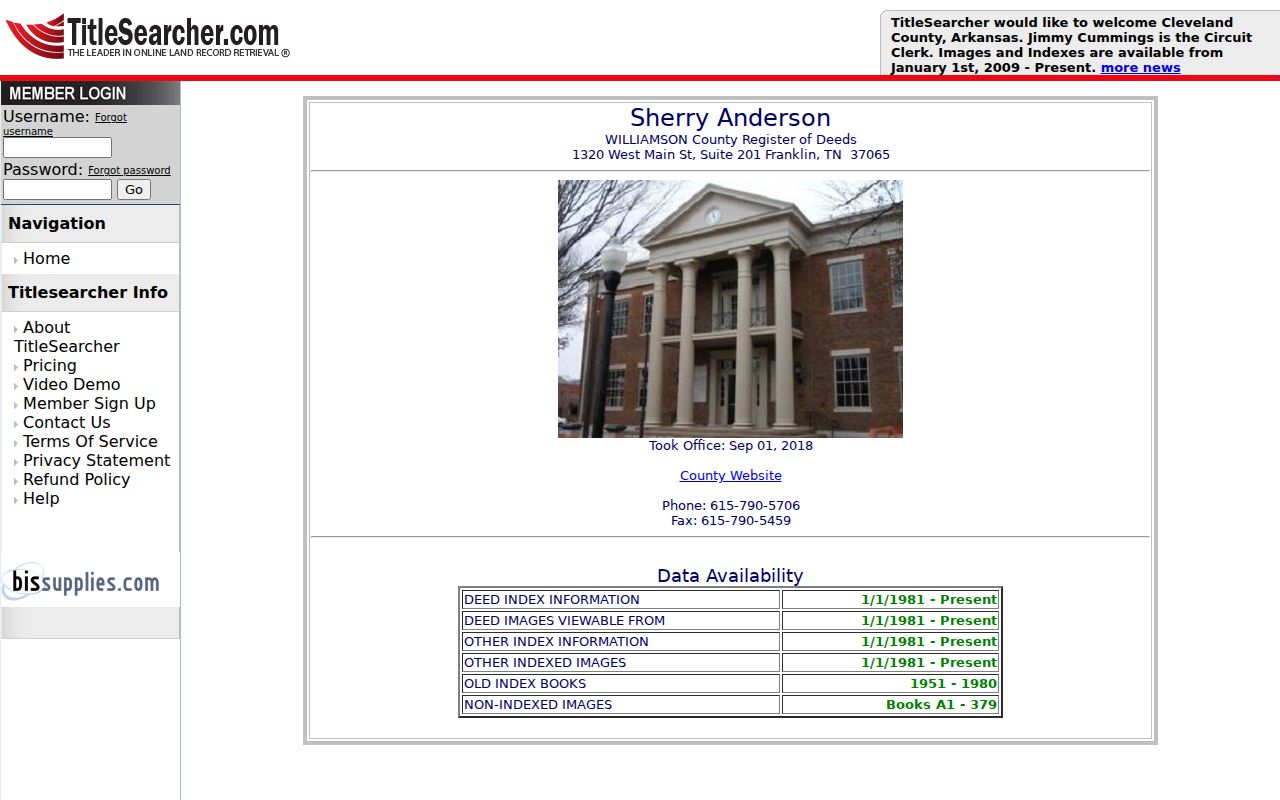
The coverage display is a useful reminder that an online index is only one segment of the Williamson County deed trail, not the full history of a parcel.
Williamson County Archives Name Routes
The Williamson County Archives index has more than 405,000 entries. Its Name Search accepts first and last name fields and allows selected record groups. Keyword Search supplies all-terms or any-term matching, and Field Search changes with the selected record group. Public categories include deeds, court records, marriages, probate, wills, burials, obituaries and death notices, taxes, road records, ordinary licenses, inquests, and chattel mortgages.
An index result is a citation lead. It commonly points to microfilm, a bound record book, or loose material instead of an online scan. Call, email, visit, or order a copy from the Reading Room after saving the exact reference. That extra step matters when a surname has variants or the online metadata shows an unusual date range.
- Roll
- A record series maintained for an administrative purpose, such as property or voter registration.
- Index
- A finding tool that points to a record, not necessarily the record image.
- Parcel
- A mapped unit of land tied to an assessor identifier and legal description.
- Criss-cross directory
- An address-arranged directory, if a local volume contains one, used to check an historical occupant.
Note: The Archives index is strong for historical leads, but modern records should be requested from their current county office.
Williamson County Courts and Certificates
For a court question, distinguish the courthouse file from an online search screen. Williamson Circuit Court, Clerk & Master, General Sessions Civil, and General Sessions Criminal are participating local offices in the Tennessee Case Information System, but no verified public county trial-court search URL was found during the research. The Tennessee appellate search is a separate official route. A clerk can provide the correct local file or copy process after a case number or case details are identified.
Tennessee Vital Records handles certificates statewide. Eligibility and copy rules are controlled by T.C.A. §§68-3-205 and 68-3-206. Birth records open after 100 years, while death, marriage, divorce, and annulment records open after 50 years under the cited statute, subject to confidential portions and custody rules. A historical Archives hit is not a substitute for a certified record.
Williamson County Resident Affiliations
Some searches begin with an organization rather than an address. Tennessee's Business Entity Search accepts a business name or Secretary of State control number and can lead to filings, certificates, and UCC services. When a public filing displays officers, managers, a registered agent, or an organizational address, it establishes an official business relationship. It does not establish a personal residence.
The state's Verify portal is another narrow source. It checks regulated individual or company credentials, status, expiration, and public discipline where supplied. Use a license or filing only as one source in a Williamson County residents directory search. A name should still be checked against the location and time period through property, court, Archives, or other appropriate records.
Franklin business licensing and the Williamson County Clerk are office routes for local license material, but the reviewed official sources did not provide a verified public name-search register. Ask the custodian for the specific existing record rather than guessing at a database.
Williamson County Records Request Fallback
When no portal supplies the record, use the Tennessee Public Records Act, T.C.A. §§10-7-501 et seq., especially §10-7-503, with the office that actually holds it. Williamson County's policy allows an oral or written request to inspect, while a request for copies or inspect-and-copy uses a written form. A request must identify an existing record with reasonable specificity. The county is not required to research a question or build a new resident list.
The county policy calls for valid Tennessee identification or an approved alternative ID. Inspection is free. The stated copy rates are 15 cents per black-and-white letter or legal page and 50 cents per color page, with possible labor after one hour and advance payment for an estimated cost above $10. The custodian should provide the record, deny it in writing, or give a reasonable time estimate within seven business days.
| Online source | Fastest for a defined field or current entry |
|---|---|
| Office or Reading Room | Best for books, files, microfilm, and uncertified gaps |
| Specific TPRA request | Use for an identified existing county record not available through either route |
Historical Williamson County Directory Trails
Williamson County Public Library Special Collections in Franklin holds city directories, yearbooks, newspapers, cemetery and Bible records, local histories, military material, court records, and microfilm. The collection is noncirculating, with staff assistance, guest computer passes, and free Wi-Fi. Its official pages confirm city-directory holdings but do not publish a complete local publisher list, year run, or verified reverse-directory shelf. Ask staff for the exact volume before treating a year as available.
The library's newspaper microfilm helps bridge a missing volume. Verified runs include the Western Weekly Review for 1831-1861 and 1865-1893, and the Franklin Review Appeal from 1899-2004 with listed splits. A directory address can be tested against a legal notice, obituary, deed, tax record, or census. The detailed methods and collection limits belong on the Williamson County City Directory page.
Williamson County Record Layers Since 1799
Williamson County was formed in 1799 from Davidson County, with Franklin selected as the county seat. The history is layered rather than missing in one block. Early books, WPA microfilm, newspapers, and archival collections lead into printed directories and then current parcel, voter, and deed systems. The present courthouse was built in 1856-58 and was damaged in an 1873 tornado, but the reviewed official history does not document a wholesale records loss.
That history changes how a residents directory should be read. A January 1, 1981 online deed boundary is an imaging and access boundary, not proof that earlier ownership is gone. The Archives and state finding aids preserve routes to deeds, wills, court minutes, tax books, census indexes, and local microfilm. When a result is absent, ask first which custodian, book, or index series covers the period.
Williamson County Address Match Checks
A good Williamson County residents directory search follows a small chain rather than a single name. Compare the Assessor's situs address with the GIS parcel and legal description. Compare a deed party to the same parcel or subdivision, not only the street label. Compare a voter match only when the public tool returns one. For earlier people, combine an Archives citation with a newspaper, probate, burial, or library source that supports the same era.
Postal geography also needs a check. The county map displays three distinct Franklin ZIP codes, 37064, 37067, and 37069, while county communities and corporate limits are separate map layers. The USPS ZIP Lookup verifies delivery formatting, but it does not confirm that a person receives mail at an address. Save the map date and the portal date with every useful result.
Williamson County Residents Privacy Checks
Before sharing or relying on a result, identify what kind of address it is. An old deed mailing address, an organizational address, a current parcel situs, and a protected voter address have different meanings. Tennessee Safe at Home provides a substitute-address program for eligible victims of specified crimes. It does not make every historic record disappear, and it does not justify trying to reconstruct a protected location from other records.
Correction begins with the office that maintains the item: the Assessor for parcel information, the Election Commission for registration, the clerk for a court record, Vital Records for a certificate amendment, or the Secretary of State for a filing. Tennessee's Information Protection Act became effective July 1, 2025 for covered consumer-data rights. It does not automatically remove independently public county records. For a suspicious deed alert, verify directly with the Register rather than treating an alert message as a certified instrument.
Note: A careful Williamson County search preserves enough detail to verify a record while avoiding publication of sensitive personal information.