
Williamson County City Directory Collections
Williamson County historical research starts with a practical fact: the public library confirms that it holds historical volumes, while its public collection description does not publish individual directory years, publishers, call numbers, or a reverse-directory shelf. Ask Special Collections to identify each available Williamson and Franklin volume before recording a range. The collection has other useful companions, including yearbooks, court material, tax records, cemetery books, local histories, periodicals, and microfilm. The records below are distinct sources, so a name found in one is a lead to test in another.
| Collection | Years | Where Held | Access |
|---|---|---|---|
| WCPL historical volumes | Individual years not published online | WCPL Special Collections | Noncirculating; confirm shelf run with staff |
| Archives online index | More than 405,000 entries; varies by record group | Williamson County Archives | Free public index; source may be a book, reel, or file |
| Library newspaper microfilm | Western Weekly Review 1831-1861 and 1865-1893; Franklin Review Appeal 1899-2004 | WCPL Special Collections | Staff-assisted reels and local-history research |
| Franklin Sanborn maps | 1888, 1893, and 1898 | Library of Congress and local preservation routes | Building and street context, not an occupant list |
| WCHS journals | Yearly issues since 1970; journals 1-54 searchable | Williamson County Historical Society | PDF articles and master article index |
Neither a missing year nor a missing web scan proves that a directory was never printed or preserved. It may be on a library shelf, in a different title, or absent from the public finding aid. Record the volume title and its publication year from the item itself. Note: A directory entry identifies what its compiler printed for that year, not a complete or current list of people at an address.
Williamson County City Directory Desk
Williamson County Public Library Special Collections at 1314 Columbia Avenue in Franklin is the local shelf-and-microfilm route. The room is noncirculating, and staff provide local-history and genealogy assistance. It is open Tuesday, Wednesday, Friday, and Saturday from 9:30 a.m. to 5:30 p.m., and Thursday from noon to 8:00 p.m. It is closed Monday and Sunday. Guest computer access, free Wi-Fi, and help with library-card resources give a researcher a useful fallback when a directory is not digitized.
WCPL Special Collections
Phone: 615-595-1246
Location: 1314 Columbia Avenue, Franklin, TN 37064
Ask for: historical volumes, newspaper microfilm, yearbooks, and local-history materials.
The library also links to a staff-generated genealogy and local-history database with births, family histories, marriages, veterans, African-American genealogy, local news, and searchable obituaries. Its Digital Resources page distinguishes remote access from in-library access: Ancestry Library Edition is in-library only, while Fold3 is available remotely with a library card. These sources can support a directory lead, but they do not establish an unverified local city-directory run.
Williamson County Archives Directory Clues
The free Williamson County Archives index is a strong companion when library volumes leave a gap. It has Name Search, Keyword Search, and Field Search modes. Name searching offers last-name and first-name fields, while keyword searching can match all terms or any term. Researchers can limit a search to record groups such as deeds, court records, marriages, probate, obituaries and death notices, burials, taxes, and wills. An entry points to a source reference, not automatically to a scan.
| Deed result | Grantor or grantee, year, document, and book or page. |
|---|---|
| Court result | Case style, cause of action, year, and case number. |
| Probate result | Name, filing date, closing year, and case number. |
| Burial result | Cemetery name, alternate cemetery name, and book or page. |
Use the result as a citation trail. The original may be microfilm, a bound record book, or a loose file in the Reading Room at 611 W. Main Street, Franklin. Archives staff can help by phone, mail, or email with a narrow request that includes name variants, an era, a place, and the record group. Modern deeds and other current records belong with the current custodian instead.
Williamson County Directory Gaps in Print
Newspapers can bridge a Williamson County directory gap when no confirmed volume covers the year at hand. The library’s microfilm guide names several usable runs: Western Weekly Review, 1831-1861 and 1865-1893; Review and Journal, October 31, 1878 through September 1, 1881; Franklin Review Appeal, 1899-1921 and 1922-2004; and Franklin Williamson County Leader, 1973-1995. A legal notice, estate notice, obituary, or address-bearing advertisement can place a name in time without pretending to be an annual resident roll.
Search a surname with a street, a cemetery, a church, or a nearby community name. Keep initials, maiden names, suffixes, and spelling variants in the notes. The county’s Guide to Local Newspapers provides the title and coverage clues needed to choose the reel first. A blank search is still useful evidence that the selected title or date needs another source.
Note: The microfilm guide establishes title coverage, but it does not make every address mention a verified household record.
Williamson County City Directory Map Context
An old Williamson County listing is easier to read when its address can be set beside the street pattern of its era. Preservation resources confirm Franklin Sanborn maps for 1888, 1893, and 1898. The January 1898 Franklin Sanborn map is a six-sheet scan that can show building footprints, block form, street names, and land use. It cannot identify an occupant by itself. Pair it with a directory, deed, newspaper notice, or other named source.
Do not assume that an older street number matches today’s number. The research did not identify a verified countywide renumbering year or a confirmed renamed-street conversion. A parcel description, lot, subdivision, plat, neighboring names, and a Sanborn sheet are better continuity checks than a guess based on a familiar address. For a present-day parcel workflow, use the address-focused Williamson County street directory route rather than treating the historical shelf as a current ownership search.
Reading a Williamson County City Directory Entry
No public official scan supplied an actual Franklin or Williamson directory entry for inspection. That matters. The available local research does not verify a local abbreviation key, spouse convention, owner mark, reverse section, or publisher. When staff provides a volume, capture its title page and front matter before interpreting an entry. The Library of Congress describes common directory patterns, but those are a checklist for the physical item, not proof that a local volume used every field.
| Name | Record the surname, given name, initials, and every spelling exactly as printed. |
|---|---|
| Relationship note | A spouse or other relation may appear, but confirm the convention in that volume. |
| Work description | An occupation, business, or professional description may appear in some directories. |
| Street address | Copy the number, street abbreviation, and any directional prefix or suffix. |
| Ownership notation | Do not infer an owner or renter mark unless the volume’s key explains it. |
- Criss-cross directory
- An address-organized directory used to look for a listed occupant from a street address. WCPL confirms city directories, not a particular local criss-cross run.
- Householder index
- A listing organized around a household head or address. Its presence must be checked in the volume.
- Abbreviation key
- The publisher’s explanation of shortened terms, usually found in front matter. Photograph or transcribe it with the entry.
Williamson County Historical Society Directory Clues
The Williamson County Historical Society journal archive provides a different kind of directory clue. Its yearly journals run from 1970 onward, journals 1 through 54 are searchable as PDFs, and a master article index helps match people, places, organizations, and local events. A journal is not an annual address book. It can, however, supply the place context that makes a surname, church, cemetery, road, or historical organization easier to trace in the library or Archives.
The journal archive and its searchable article index show the Historical Society collection used beside the library shelf.
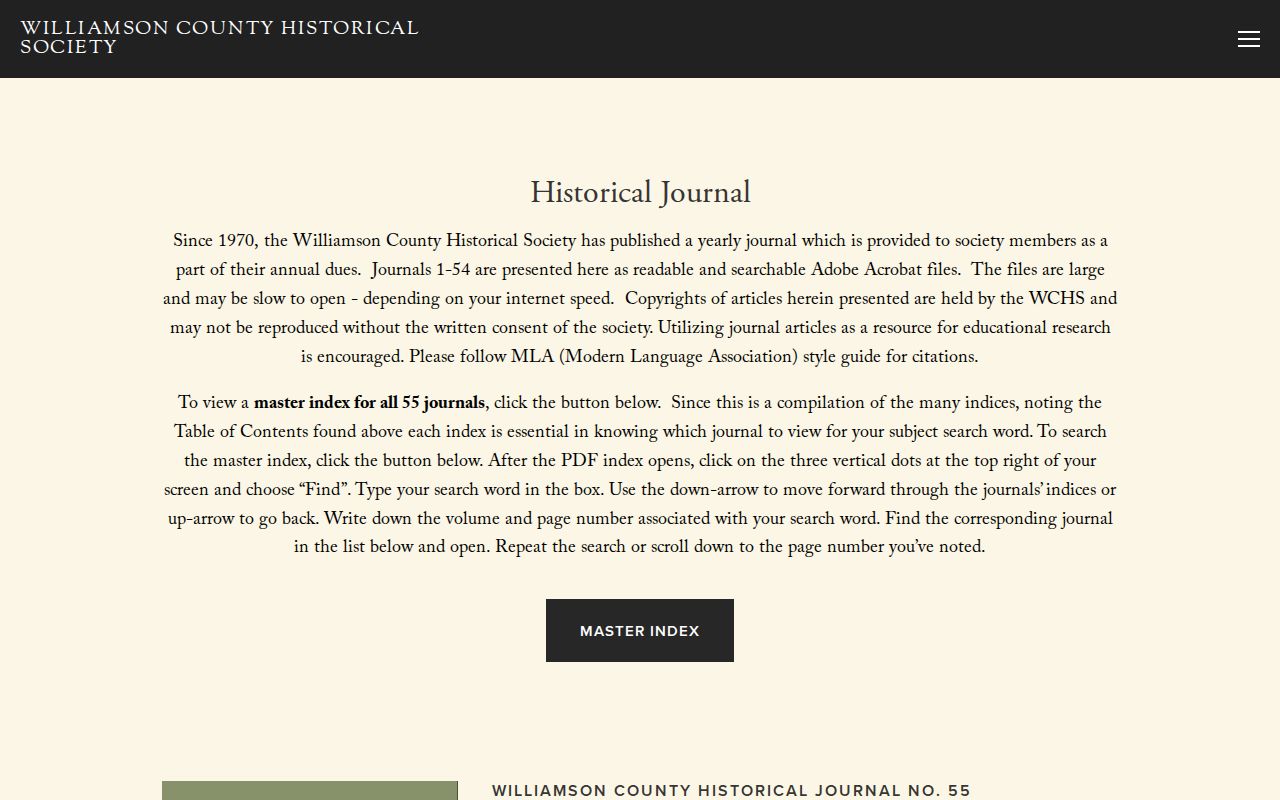
Use a journal hit to refine the next directory or Archives search, then cite the original volume or record reference separately. That comparison keeps a historical article from being mistaken for proof of a person’s address.
Note: Journal articles provide context, while directory volumes and archival records remain the sources for dated address claims.
Trace a Williamson County City Directory Household
A household trail works best when every source gets its own date and spelling note. Begin with the newest confirmed directory volume, not an assumed year. Then work backward and forward in the volumes staff identifies. Compare the address with nearby listed names and with a newspaper notice from the same period. Federal census records can add household composition at census time, but they do not provide annual continuity and become public under the 72-year release rule.
- Ask WCPL staff for the available directory years and copy the title-page details from each volume used.
- Record the name, address, initials, and every printed abbreviation from the first matching entry.
- Check an address or criss-cross section only if the volume contains one, then note nearby listed names without assuming a relationship.
- Pair each directory year with the nearest available census, newspaper, tax, deed, or probate reference.
- Use the Archives index or searchable obituaries to locate a source citation when a name disappears from a later volume.
A disappearance can mean a move, death, a changed spelling, an unlisted person, or a gap in the surviving run. It is not a conclusion by itself. Probate, burial, obituary, and deed references can help test the next step, especially when the person left Franklin or the street address changed.
Williamson County City Directory Limits
Historical volumes are not a complete present-day resident roll. An old listing may name an occupant, a business contact, or an address that later changed, and an Archives index hit can lead only to a physical source. The county’s current property and deed routes answer different questions. Personal historical research should stay focused on family history, local history, estate matters, or a property’s documented past. Do not use old addresses or listings to stalk, harass, or harm anyone.
When a source is unscanned, the Reading Room, library staff, and a focused Tennessee Public Records Act request to the proper custodian are the documented fallback routes. The county is not required to create a new research list or answer a broad research question.